Everyone wants a piece of you
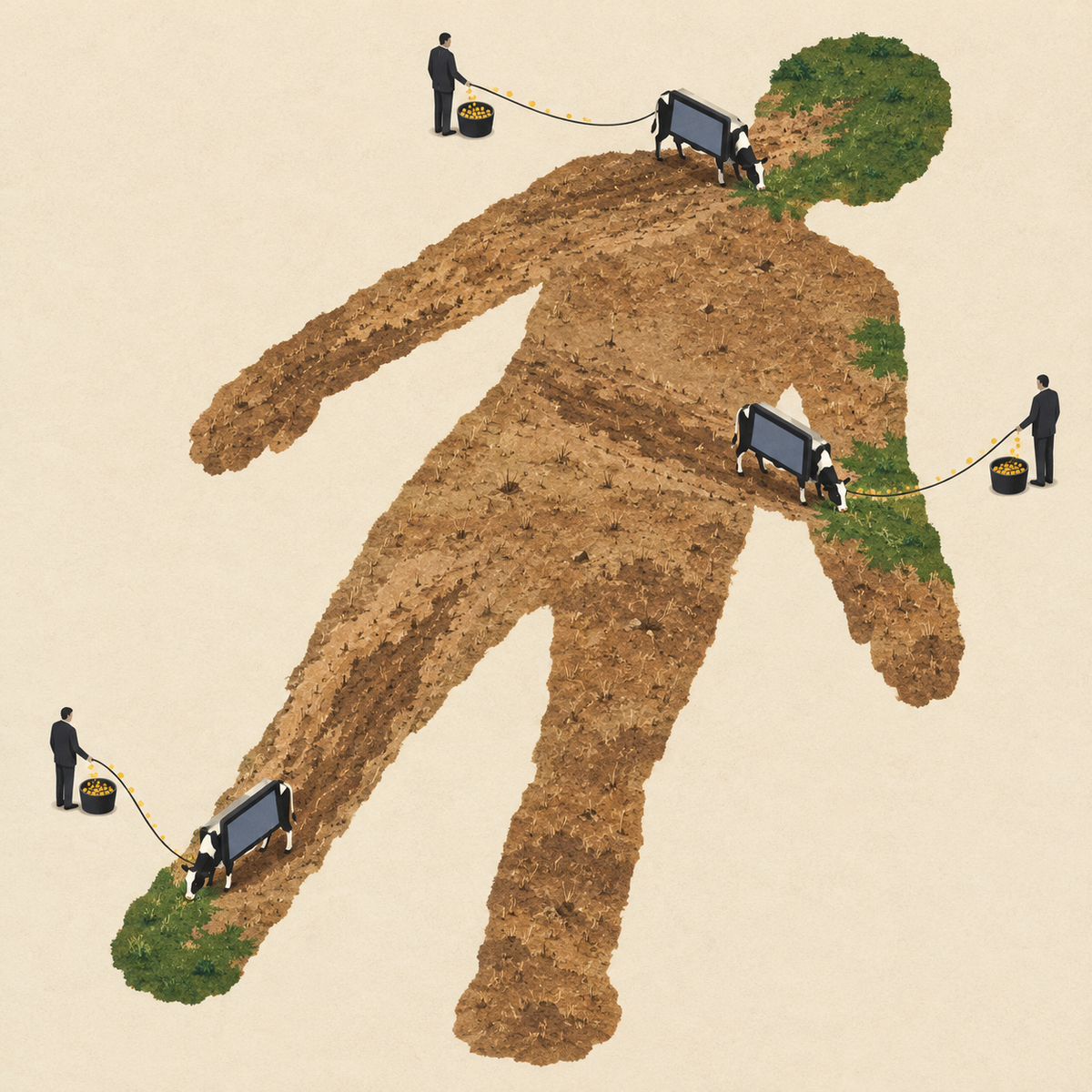
Every company wants a little more of your money, time and attention. But how fast can you grow back? A tech tragedy of the commons, with humans as the pasture.pasture.
Your next phone would like a share of your savings. Your streaming services would like a monthly allowance. Your favorite apps would appreciate the rest of your evening.
Each proposition can be perfectly reasonable. The phone might be excellent. The subscription might be worth keeping. Watching videos can even be a fine way to spend an evening. Unfortunately, they are all making plans for the same person.
Each company has its own growth targets, usually degenerating into enshittification. You have one income, one day and a decidedly non-upgradable need for sleep. A durable product, an uncrowded evening, money left in your account: from the other side of the transaction, these can look like opportunities. If everyone becomes better at extracting from us, how quickly are we supposed to grow back?
The tragedy of the commons usually concerns a pasture or fishery. Each participant benefits from taking more, while the consequences of depletion spread beyond them. Without workable limits, individually advantageous decisions can undermine the resource everyone depends on.
Now put a person where the pasture was. Companies compete for our money and attention. Employers need our effort and expertise. Public services require paperwork. Family and friends need us too, although affection is not best understood as a subscription tier.
Different demands. Same person. Nothing extra in the tank. The important limit is replenishment. Savings recover when income exceeds expenses. Energy requires rest. Tomorrow brings another day, but no refund for this one.
Renewable does not mean inexhaustible.
Yet leaving something behind is rarely a company’s growth target. A phone upgrade brings spending forward. A subscription claims part of next month’s income, and making cancellation difficult only rarely backfires as in Amazon’s $2.5 billion Prime settlement.
The same pursuit extends to the evening. TikTok’s infinite scroll removes stopping points; a connected television can turn a hardware purchase into an ongoing advertising relationship. Samsung and LG offer optional viewing-recognition features, so even the screen can take an interest in what keeps you watching.
“Then show restraint” would sound sensible for companies to adopt. It is also where the trap begins. Each company that leaves money in your pocket cannot reserve it for your future needs. A platform that lets you leave cannot stop another from claiming the next hour. Restraint can carry an immediate competitive cost: its benefits are available to everyone else.
This depletion does not even require enshittification. Several excellent subscriptions, a genuinely useful phone upgrade and an entertaining feed can still make incompatible demands on one life. Each service can remain good while their combined demands become unsustainable.
Ok, people are not literally a commons. Our resources do not belong to a committee of interested businesses... And that is precisely the objection!
We cannot just ask companies to take less while their competitors keep taking more. We need rules that make products last, services easy to leave, and time off actually time off.
A customer with money left next month is not a missed opportunity. A worker with energy left tomorrow is not unused capacity. And an evening nobody managed to monetize might simply be a life.